
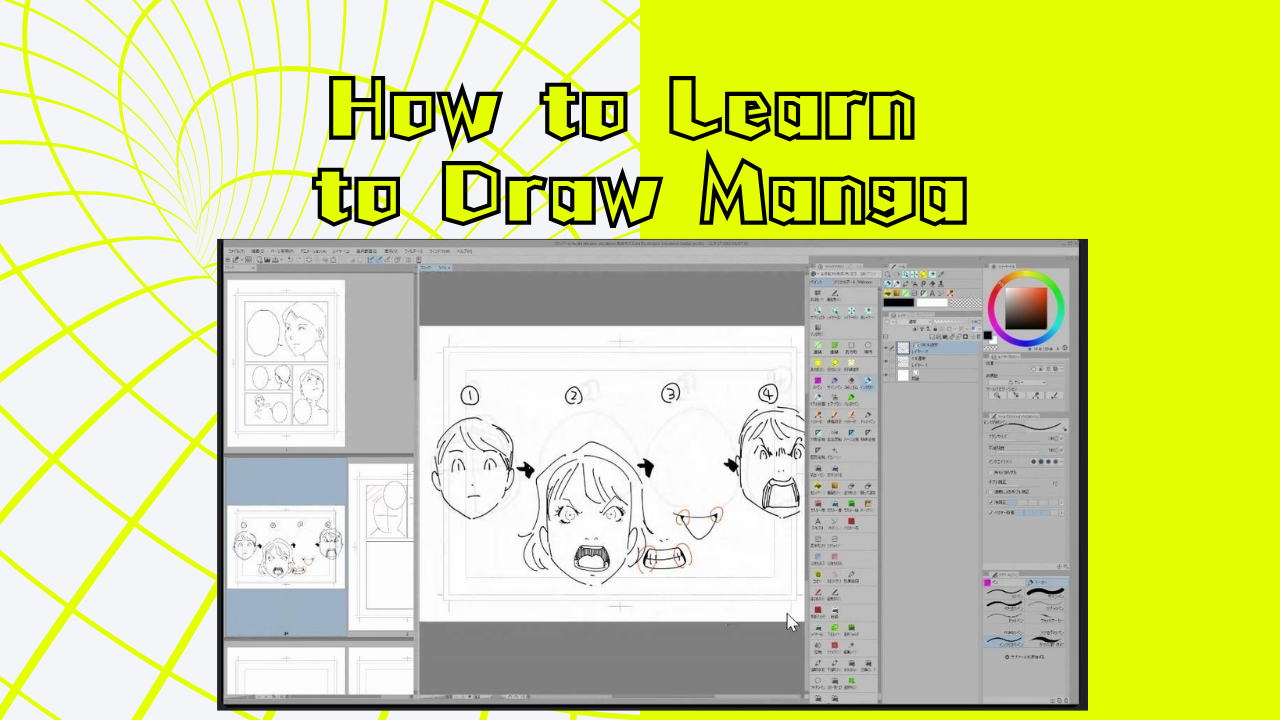
Do you want to learn how to draw manga but aren’t sure where to start?
Maybe you love manga and anime and have already tried drawing your favorite characters. Or perhaps you’ve watched tutorials online but feel overwhelmed by everything you need to learn:
Faces, anatomy, poses, hands, clothing, backgrounds, panels, storytelling…
The good news is that you don’t need to learn everything at once.
Learning manga is a step-by-step process.
In this guide, we’ll introduce a practical roadmap for beginners who want to learn how to draw manga, based on the skills taught by professional Japanese manga artists.
At MANGA DOJO Online, students around the world learn manga live from professional manga artists in Japan, with English interpretation.
Let’s start with the fundamentals.
Can Anyone Learn to Draw Manga?
Yes.
You don’t need to be “naturally talented” to start drawing manga.
Like any creative skill, manga drawing improves through a combination of:
Learning → Practice → Feedback → Repetition
Beginners sometimes compare their first drawings with professional manga artwork and become discouraged.
But professional artists have usually spent years developing their skills.
Instead of asking:
“Am I good enough to draw manga?”
a better question is:
“What should I learn next?”
Having a clear learning order makes manga drawing much easier to approach.
How to Learn Manga Drawing Step by Step
If you’re a beginner, we recommend building your skills in roughly this order:
Faces
↓
Eyes & Expressions
↓
Hair
↓
Body Proportions
↓
Anatomy
↓
Poses
↓
Clothing
↓
Character Design
↓
Manga Panels
↓
Storytelling
Let’s look at each step.
Step 1: Learn How to Draw Manga Faces
For many beginners, the face is the easiest place to start.
Instead of immediately focusing on detailed eyes or hairstyles, first learn the basic structure of the head.
Practice:
- Head shapes
- Facial guidelines
- Eye placement
- Nose placement
- Mouth placement
- Front views
- Side views
- 3/4 views
Guidelines are especially useful when you’re learning to draw the same character from different angles.
A common beginner problem is being able to draw a character from the front but struggling as soon as the head turns.
Understanding the basic structure underneath the face will make different angles much easier.
Step 2: Practice Manga Eyes and Facial Expressions
Manga characters communicate a lot through their faces.
Changing just a few elements can completely change the emotion of a character.
Try practicing:
Happy
Sad
Angry
Surprised
Embarrassed
Scared
Confident
Pay attention to more than just the eyes.
Eyebrows and mouth shapes are also essential for creating convincing expressions.
For example, instead of drawing ten different characters, try drawing one character with ten different emotions.
This is an excellent exercise for beginners.
Step 3: Learn How to Draw Manga Hair
Hair is one of the most recognizable parts of manga character design.
A common beginner mistake is drawing hair as individual lines.
Instead, try thinking about hair as larger shapes and sections.
Consider:
- Overall silhouette
- Hairline
- Bangs
- Side hair
- Back hair
- Volume
- Direction
- Movement
Then think about the character.
Would this character have neat hair?
Messy hair?
Long flowing hair?
Short energetic hair?
A hairstyle can communicate personality before the character even says anything.
That’s why manga hair is not only a drawing technique — it is also part of character design.
Step 4: Understand Manga Body Proportions
After becoming comfortable with faces, start drawing the entire body.
Don’t worry about detailed muscles yet.
First, understand basic proportions.
Practice simple figures and pay attention to:
- Head-to-body ratio
- Shoulder width
- Torso length
- Arm length
- Leg length
- Hip placement
- Hands and feet
Manga proportions can vary dramatically depending on the style.
A realistic manga character may have very different proportions from a chibi character.
But even stylized characters are easier to draw when you understand the basic human structure underneath them.
Step 5: Study Anatomy for Manga
Do you need to become an anatomy expert to draw manga?
No.
But basic anatomy can dramatically improve your characters.
Rather than memorizing every muscle, beginners should first understand how major parts of the body connect.
Focus on:
- Head and neck
- Shoulders
- Rib cage
- Pelvis
- Arms
- Legs
- Elbows
- Knees
- Hands
- Feet
One useful technique is to simplify the body into basic forms.
For example:
Head = sphere
Torso = box or simplified rib cage
Arms and legs = cylinders
This makes complicated poses much easier to understand.
Step 6: Learn to Draw Dynamic Manga Poses
Once you understand basic anatomy, stop drawing every character standing straight.
Manga is visual storytelling.
Characters need to move.
Practice poses such as:
- Walking
- Running
- Sitting
- Jumping
- Turning
- Fighting
- Reaching
- Falling
One useful concept is the line of action.
Imagine one main line running through the character’s body that represents the direction and energy of the pose.
A strong line of action can make even a simple sketch feel more dynamic.
Step 7: Learn How Clothing Follows the Body
A character doesn’t exist separately from their clothing.
When the body moves, the clothes move too.
Pay attention to where fabric:
- Stretches
- Compresses
- Folds
- Hangs
- Overlaps
Instead of memorizing random folds, think about what the body underneath the clothing is doing.
Clothing is also an important character-design tool.
A school uniform, oversized hoodie, formal suit, fantasy armor, or streetwear outfit can immediately tell the reader something about a character.
Step 8: Create Your Own Manga Character
Now you can start combining everything you’ve learned.
Instead of only copying existing manga or anime characters, try creating an original character.
Ask yourself:
Who are they?
How old are they?
What is their personality?
What do they want?
What are they afraid of?
How do they dress?
How do they move?
Then translate those answers into visual choices.
For example, a confident character and a shy character might have completely different:
- Postures
- Expressions
- Hairstyles
- Clothing
- Silhouettes
This is where drawing becomes character design.
Step 9: Move from Character Drawing to Manga Panels
This is a major step.
Many aspiring manga creators reach a point where they can draw characters but don’t know how to create an actual manga page.
That’s completely normal.
Drawing manga characters and creating manga are different skills.
Manga requires you to think about how multiple images work together.
You’ll need to learn concepts such as:
- Panel layout
- Panel size
- Reading direction
- Camera angles
- Close-ups
- Wide shots
- Speech balloons
- Sound effects
- Page composition
A manga page should guide the reader naturally from one moment to the next.
Good paneling doesn’t simply make a page look attractive.
It controls how the reader experiences the story.
Step 10: Learn Manga Storytelling
Eventually, manga becomes more than drawing.
It’s storytelling.
Even beautiful artwork can be difficult to read if the story isn’t communicated clearly.
Aspiring manga creators should gradually learn:
- Story structure
- Character goals
- Conflict
- Storyboarding
- Scene composition
- Dialogue
- Pacing
- Tension
- Climax
- Character relationships
This is the transition from being someone who draws manga-style illustrations to someone who can create manga stories.
How Long Does It Take to Learn Manga Drawing?
There is no single answer.
It depends on:
- Your current drawing experience
- How often you practice
- What skills you want to develop
- Your goals
- The complexity of your art style
Someone who practices regularly will usually progress differently from someone who draws once every few months.
Rather than asking:
“How long until I’m good?”
try asking:
“What can I improve this month?”
Manga skills develop gradually.
That’s why consistency matters.
How Often Should You Practice Manga Drawing?
You don’t necessarily need to draw for five hours every day.
For many students, shorter but consistent practice is more realistic.
For example:
20–30 minutes several times per week
can be more sustainable than drawing for six hours once and then not drawing again for three weeks.
You can also give yourself small challenges:
Day 1: Faces
Day 2: Expressions
Day 3: Hands
Day 4: Poses
Day 5: Character design
The goal is to make drawing part of your routine.
Should You Copy Manga When Learning to Draw?
Studying professional artwork can help you understand how experienced artists solve visual problems.
You can study:
- Facial construction
- Poses
- Panel composition
- Expressions
- Clothing
- Backgrounds
However, your long-term goal should be to understand why the drawing works rather than simply copying it.
Ask yourself:
Why did the artist use this angle?
Why is this panel larger?
Why is this expression effective?
Why does this pose feel dynamic?
Learning to analyze manga is just as useful as learning to draw it.
And when sharing or publishing your work, make sure you respect the original creator’s copyright and develop your own original artwork.
Can You Learn Manga by Yourself?
Yes.
Many artists begin by teaching themselves.
There are now countless resources available:
- Manga drawing books
- YouTube tutorials
- Online articles
- Art communities
- Reference websites
- Recorded courses
Self-study can be extremely valuable.
But it also has one major challenge:
You are responsible for identifying your own mistakes.
You may look at your drawing and know something feels wrong without understanding why.
This is where feedback can accelerate learning.
An experienced manga artist may immediately notice that:
- Your shoulders are unbalanced
- Your pose lacks weight
- Your proportions change between panels
- Your perspective is inconsistent
- Your panels don’t guide the reader clearly
Knowing what to practice next can save a lot of frustration.
Online Manga Classes vs. Self-Study
You don’t have to choose only one.
In fact, combining both can work very well.
You might use free resources for additional practice while following a structured online manga class for direction and feedback.
A class can provide:
Structure + Deadlines + Professional Instruction + Feedback
while independent practice gives you:
Freedom + Experimentation + More Drawing Time
Together, they can create a strong learning environment.
If you’re looking for structured instruction, read our guide to choosing the best online manga classes and what to look for before enrolling.
Learn Manga from Professional Japanese Manga Artists
For students who specifically want to study manga, learning from someone with professional manga experience can provide a different perspective from general illustration classes.
At MANGA DOJO Online, students learn through live online classes taught by professional Japanese manga artists.
Our head instructor, Kazuo Maekawa, has more than 30 years of professional experience and is known for his work on the manga adaptation of Ace Attorney (Gyakuten Saiban).
Our classes include live English interpretation, so you don’t need to speak Japanese.
Students can join from the United States, Europe, Asia, Australia, or anywhere else with an internet connection.
Which MANGA DOJO Online Class Should I Choose?
We currently offer two main learning paths.
Character Illustration – Beginner
Choose this course if you want to improve:
- Faces
- Expressions
- Hairstyles
- Body proportions
- Anatomy
- Poses
- Clothing
- Character design
This is our recommended starting point for beginners.
The course is available for students ages 6 and up.
Manga Creation – Intermediate
Choose this course if you can already draw characters and want to learn how to create manga.
Topics include:
- Character drawing
- Anatomy
- Manga paneling
- Reading flow
- Storyboarding
- Speech balloons
- Sound effects
- Inking
- Backgrounds
- Character relationships
- Pacing
- Storytelling
A simple way to choose is:
“I want to get better at drawing characters.”
→ Character Illustration
“I can draw characters and want to make my own manga.”
→ Manga Creation
How MANGA DOJO Online Works

MANGA DOJO Online isn’t designed as a course where students simply watch videos.
Our 12-Lesson Course follows a continuous learning cycle:
Live Class → Assignment → Submit → Professional Feedback → Improve
Students attend a live class, practice the lesson, complete an assignment, and submit their work through Google Classroom.
A professional manga artist then provides feedback to help the student understand what to improve.
This cycle continues throughout the semester.
A One-Year Manga Learning Journey
Students who want to study manga continuously can progress through our structured one-year learning program.
The year is divided into four 3-month semesters.
Each semester includes:
12 Live Lessons
+
Assignments
+
Professional Manga Artist Feedback
+
PDF Certificate of Completion
After completing one semester, students can continue to the next level.
The goal isn’t to become perfect in three months.
It’s to keep moving forward:
Learn → Practice → Get Feedback → Improve → Level Up
From Learning Manga to Creating Your Own Manga
For some students, manga drawing is simply a fun creative hobby.
For others, it becomes something more.
You may eventually want to:
Create an original manga
↓
Build a portfolio
↓
Enter manga competitions
↓
Have your work reviewed by professional editors
↓
Pursue opportunities in the manga industry
MANGA DOJO Online wants to support students not only in learning drawing techniques but also in understanding the path toward becoming manga creators.
Today, international creators can even find opportunities to submit their work online to Japanese publishers.
If that’s your goal, you can also read our guide:
Can You Submit Your Manga to a Japanese Publisher in English?
Start Learning Manga Today 🇯🇵
You don’t need to wait until you’re “good enough.”
You don’t need to live in Japan.
And you don’t need to learn everything before you start.
Start with one face.
Then another expression.
Then a body.
Then a pose.
Then a character.
Then a panel.
Then a story.
Every manga artist starts by learning.
Try a FREE Online Manga Lesson from Japan
If you’d like to experience a real manga class before enrolling, MANGA DOJO Online regularly offers FREE Online Trial Lessons.
You can experience:
✓ Live manga instruction from Japan
✓ A professional Japanese manga artist
✓ Live English interpretation
✓ Beginner-friendly instruction
✓ Manga drawing techniques you can practice at home
Join a FREE Online Manga Trial | MANGA DOJO Online
Learn Manga from Japan, Wherever You Are. 🇯🇵✍️



Comments